
Introduction
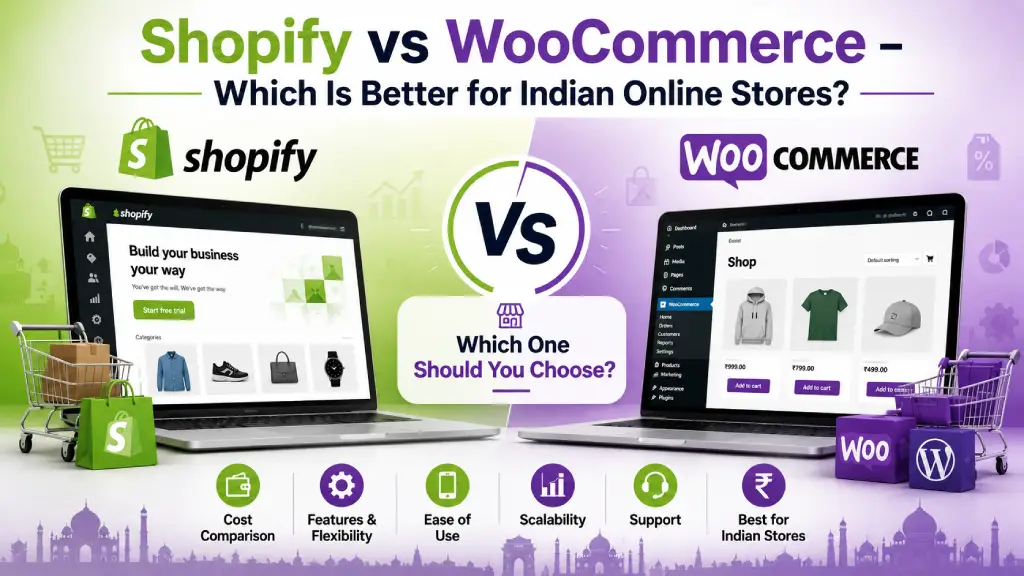
India’s eCommerce industry is expanding rapidly, and businesses planning to launch online stores in 2026 must select the right platform for long-term success. Among the leading Ecommerce Website Development platforms, Shopify and WooCommerce continue to dominate the Indian online retail market due to their powerful features, mobile-friendly experiences, AI-driven tools, SEO capabilities, and scalability. However, deciding between Shopify and WooCommerce can be challenging because both platforms cater to different business requirements. Shopify is ideal for businesses seeking an easy-to-manage, secure, and fast-to-launch solution, whereas WooCommerce is better suited for companies looking for complete customization, greater ownership, advanced SEO flexibility, and full control over their online store.
Modern Indian consumers expect much more than a basic online shopping experience. Today’s customers demand fast-loading websites, seamless mobile browsing, AI-powered product recommendations, secure payment gateways, voice search compatibility, personalized shopping journeys, and reliable delivery support. Businesses that fail to meet these expectations often face lower customer engagement, reduced conversions, and poor retention rates. As a result, choosing the right Ecommerce Website Development platform has become a critical business decision for startups, D2C brands, SMEs, and enterprise-level companies across India. Before investing in professional Shopify Website Development or WooCommerce Website Development services, businesses should carefully evaluate factors such as long-term operational costs, SEO performance, AI integration capabilities, mobile responsiveness, scalability, security, and compatibility with the evolving Indian eCommerce market.
In 2026, Google AI Overviews, conversational search platforms, and AI-powered shopping experiences are reshaping how online businesses attract and engage customers. Modern search engines now focus heavily on user-centric content, mobile responsiveness, fast-loading websites, trust signals, and well-structured Ecommerce Website Development architecture to determine search rankings and online visibility. As competition in the Indian digital commerce market continues to rise, businesses that choose the right eCommerce platform today can achieve stronger SEO performance, improved customer engagement, higher conversion rates, and long-term scalability. Selecting a platform that supports AI readiness, technical SEO, and seamless user experiences is becoming essential for brands aiming to succeed in India’s fast-evolving online marketplace.
Understanding Shopify and WooCommerce
What Is Shopify?
Shopify is a fully hosted Ecommerce Website Development platform built for businesses that want to launch online stores quickly with minimal technical complexity. The platform takes care of hosting, server management, security updates, backups, performance optimization, and ongoing maintenance automatically. This enables business owners to concentrate more on sales, branding, customer experience, and digital marketing instead of handling technical website operations. Shopify Website Development has become extremely popular among startups, D2C brands, small businesses, and dropshipping companies because of its user-friendly interface and low coding requirements.
One of Shopify’s strongest advantages is its simplicity and fast deployment process. Businesses can create and launch professional online stores within a short time using pre-designed themes, drag-and-drop customization features, built-in payment integrations, and AI-powered tools. Shopify also provides advanced features such as CDN-based website speed optimization, mobile-friendly design, inventory management, marketing automation, and extensive third-party app integrations that simplify Ecommerce Website Development for growing brands. In 2026, many Shopify stores are integrating AI-driven technologies for personalized product recommendations, conversational shopping experiences, automated marketing campaigns, and AI-generated product descriptions. Shopify is also expanding its AI ecosystem through innovations like Sidekick AI and Agentic Commerce systems to improve automation, operational efficiency, and customer engagement.
Another major benefit of Shopify Website Development is platform reliability and scalability. During high-traffic events such as festive sales, seasonal promotions, and viral campaigns, Shopify’s cloud-based infrastructure automatically handles traffic spikes and server scaling without affecting performance. This makes Shopify an attractive solution for rapidly growing D2C brands seeking stable website performance and lower technical management risks. However, Shopify also has certain limitations, as businesses often rely on paid third-party apps for advanced customization and specialized functionality. Over time, recurring app subscription costs and transaction fees can increase the overall operational expenses for Indian eCommerce businesses.
What Is WooCommerce?
WooCommerce is a powerful open-source Ecommerce Website Development platform built specifically for WordPress websites. Unlike Shopify, WooCommerce gives businesses complete ownership of their online store along with advanced customization capabilities and greater SEO control. With WooCommerce Website Development, businesses can customize nearly every aspect of their store, including checkout experiences, product pages, URL structures, blog architecture, schema markup, AI integrations, and advanced SEO configurations. Because of this flexibility, WooCommerce is widely preferred by content-focused brands, SEO-driven businesses, and companies looking for scalable long-term Ecommerce Website Development solutions.
Although WooCommerce itself is free to use, businesses are responsible for managing hosting, website security, backups, software updates, and performance optimization separately. Compared to Shopify, WooCommerce Website Development requires stronger technical management and regular maintenance. Many businesses therefore partner with professional Ecommerce Website Development companies or experienced WordPress developers to ensure website security, plugin compatibility, and optimal performance. However, the platform offers virtually unlimited customization possibilities, making it highly suitable for businesses that require advanced functionality, custom workflows, and AI-powered personalization systems.
One of WooCommerce’s biggest strengths is its exceptional SEO flexibility. Since the platform runs on WordPress, businesses gain access to advanced SEO tools such as Rank Math and Yoast SEO, allowing deeper optimization for search engines and AI-driven search experiences. Businesses can develop strong content marketing strategies, conversational SEO structures, AI-optimized blogs, custom schema markup, and internal linking systems to improve online visibility and organic traffic growth. WooCommerce Website Development is especially beneficial for brands focused on long-term digital branding, content-driven marketing, AI search optimization, and sustainable SEO performance. Unlike Shopify, WooCommerce also provides full ownership of website data and greater freedom without dependency on platform-specific restrictions.
Shopify vs WooCommerce — Core Platform Difference
The primary difference between Shopify and WooCommerce lies in how each platform is structured, managed, and controlled. Shopify is a fully hosted SaaS (Software as a Service) Ecommerce Website Development platform that automatically handles hosting, server management, security, updates, backups, and technical maintenance. This allows businesses to launch and manage online stores with minimal technical involvement while focusing more on sales, marketing, and customer engagement.
In contrast, WooCommerce is an open-source Ecommerce Website Development solution built on WordPress, giving businesses complete control over their website infrastructure, customization, and data ownership. Businesses using WooCommerce must independently manage hosting, security, updates, backups, and performance optimization, which often requires technical expertise or professional developer support. While Shopify is designed for simplicity, speed, and operational convenience, WooCommerce is built for businesses seeking advanced customization flexibility, stronger SEO control, scalable functionality, and long-term platform ownership.
Shopify Website Development is ideal for businesses that prefer simplified store management, faster deployment, and stable managed infrastructure without handling technical complexities. It is especially suitable for startups, D2C brands, and businesses looking for quick scalability with minimal maintenance requirements. On the other hand, WooCommerce Website Development is better suited for businesses that require advanced customization, greater flexibility, powerful SEO optimization capabilities, and long-term content-driven growth strategies. WooCommerce is particularly beneficial for brands focusing on organic traffic, custom functionality, and complete control over their Ecommerce Website Development ecosystem.
Shopify vs WooCommerce Pricing in India
Pricing is one of the most important factors for Indian businesses when selecting an Ecommerce Website Development platform. Many business owners assume WooCommerce is completely free while Shopify is expensive, but the actual cost comparison is far more detailed. Long-term expenses depend on several factors including hosting, premium themes, plugins, app subscriptions, payment gateway charges, maintenance, developer support, and scalability requirements.
Shopify Pricing in India
Shopify follows a subscription-based pricing structure. In India, Shopify’s basic plans typically start at around ₹1,994 per month. However, the overall cost of Shopify Website Development can increase as businesses expand and require additional features or integrations.
Additional expenses commonly include:
- Premium themes
- Third-party applications
- Advanced integrations
- AI-powered tools
- Transaction fees
One significant limitation for Indian businesses is that Shopify Payments is currently unavailable in India. As a result, businesses must rely on third-party payment gateways, and Shopify charges extra transaction fees that generally range from 0.5% to 2% in addition to standard payment gateway charges. Businesses using multiple apps for customer reviews, cash-on-delivery systems, WhatsApp integrations, subscription management, and AI-based marketing automation may experience steadily increasing monthly operational costs.
Despite the higher recurring expenses, Shopify offers major operational advantages by including hosting, SSL certificates, CDN-based performance optimization, security management, backups, and software updates within the platform itself. This significantly reduces technical management responsibilities and minimizes dependency on developers for small and growing teams. Businesses seeking stable infrastructure, reliable performance, and simplified Ecommerce Website Development operations often prefer Shopify Website Development even with its higher monthly pricing structure.
WooCommerce Pricing in India
Unlike Shopify, WooCommerce is an open-source platform that can be downloaded and used free of charge. However, businesses must separately invest in the infrastructure and tools required to run and maintain an online store effectively. The total cost of WooCommerce Website Development depends on factors such as website size, traffic volume, customization requirements, and ongoing maintenance needs.
Common expenses associated with WooCommerce include:
- Web hosting
- Website security solutions
- Premium plugins and extensions
- Developer support and maintenance
- Performance optimization tools
- Backup and recovery systems
For most Indian businesses, quality hosting typically ranges from ₹800 to ₹2,500 or more per month depending on website traffic, storage requirements, and performance expectations. Businesses may also invest in premium SEO plugins, AI-powered tools, caching solutions, security enhancements, and advanced integrations to ensure smooth store performance and long-term scalability.
One of the biggest advantages of WooCommerce Website Development is that the platform does not impose any transaction fees on sales. This can result in significant cost savings for high-volume eCommerce businesses over time. Additionally, India has a large and highly skilled WordPress developer community, making it easier and more affordable to find professional development and maintenance support compared to many international markets.
For businesses that prioritize advanced customization, content marketing, SEO-driven growth, and long-term scalability, WooCommerce often proves to be a more financially flexible Ecommerce Website Development solution. As traffic and sales increase, businesses can scale their infrastructure according to their specific needs while maintaining complete control over operational costs and platform functionality.
What Is the Best Platform for SEO in 2026?
SEO has become a critical factor in eCommerce success as Google AI Overviews, conversational search engines, voice search, and AI-powered discovery platforms continue to reshape online visibility in 2026. Modern businesses need an Ecommerce Website Development platform that supports structured data, conversational content, mobile-first experiences, fast-loading pages, and AI-friendly optimization strategies to remain competitive in search results.
When it comes to advanced SEO flexibility, WooCommerce generally offers a higher optimization ceiling because businesses have complete control over both content and technical SEO elements. This level of control makes WooCommerce Website Development particularly attractive for businesses focused on long-term organic growth and content-driven marketing strategies.
Key SEO elements that can be fully customized in WooCommerce include:
- URL structures and permalinks
- Meta titles and meta descriptions
- Schema markup implementation
- Robots.txt configuration
- XML sitemap management
- Internal linking architecture
- Blog and content structure optimization
Because WooCommerce operates on WordPress, businesses can leverage powerful content marketing strategies, AI-optimized blogs, topic clusters, and conversational SEO techniques that align with evolving search engine algorithms. This makes WooCommerce Website Development an excellent choice for businesses that rely heavily on organic traffic, content creation, and AI search optimization.
Shopify also delivers strong SEO performance, particularly for businesses that prioritize simplicity and operational efficiency. The platform offers several built-in advantages that contribute to better search visibility and user experience.
Shopify’s SEO strengths include:
- Fast-loading website architecture
- Mobile-friendly user experiences
- Global CDN-powered performance
- Strong Core Web Vitals optimization
- Secure and managed hosting environment
However, Shopify offers less flexibility when it comes to advanced technical SEO customization. Certain elements, such as URL structure modifications and deeper server-level optimizations, are more restricted compared to WooCommerce. Nevertheless, for businesses without dedicated SEO specialists or technical teams, Shopify Website Development often provides more consistent SEO performance because the platform automatically manages website speed, security, updates, and infrastructure optimization.
SEO Verdict for 2026: WooCommerce is generally the better choice for businesses seeking maximum SEO control, advanced content marketing capabilities, and long-term organic growth. Shopify, on the other hand, is ideal for businesses that want strong SEO performance with minimal technical management and a more streamlined Ecommerce Website Development experience.
Which Platform Is Better for Indian Businesses?
The right choice between Shopify and WooCommerce depends on your business goals, technical expertise, growth strategy, and long-term digital marketing plans. Both platforms are capable of building successful online stores, but they serve different business requirements. Understanding your priorities can help determine which Ecommerce Website Development platform is the best fit for your organization.
Choose Shopify If:
Shopify is an excellent choice for businesses that want a simple, hassle-free solution with minimal technical involvement. Its managed infrastructure and user-friendly interface make it ideal for businesses looking to launch quickly and focus primarily on sales and marketing.
- You want to launch your online store quickly.
- You have limited technical knowledge or development resources.
- You prefer managed hosting, security, and maintenance.
- You need reliable performance during traffic spikes and sales events.
- You want a streamlined Ecommerce Website Development process with fewer technical responsibilities.
Shopify is particularly suitable for:
- D2C (Direct-to-Consumer) brands
- Startup businesses and first-time store owners
- Dropshipping companies
- Fast-growing online businesses seeking operational simplicity
Choose WooCommerce If:
WooCommerce is better suited for businesses that require complete control over their website, advanced customization options, and a strong focus on SEO and content marketing. Its flexibility makes it an ideal platform for long-term digital growth and highly customized eCommerce experiences.
- You want full ownership and control of your website.
- You require advanced SEO customization and optimization.
- You rely heavily on content marketing and organic traffic.
- You need custom features, workflows, or integrations.
- You want to avoid platform transaction fees and maintain lower long-term operational costs.
WooCommerce is particularly suitable for:
- SEO-focused brands
- Content-driven businesses and publishers
- Companies planning long-term scalable growth
- Businesses leveraging AI-powered Ecommerce Website Development strategies
- Organizations requiring advanced customization and complete platform flexibility
Final Recommendation: Shopify is the better option for businesses seeking speed, convenience, and simplified management, while WooCommerce is the stronger choice for businesses prioritizing SEO, customization, content marketing, and long-term ownership. The best platform ultimately depends on your business objectives, technical capabilities, and future growth plans.
Why Professional Ecommerce Website Development Matters
In today’s highly competitive digital marketplace, having a basic online store is no longer enough. Modern consumers expect seamless shopping experiences, personalized recommendations, fast website performance, and secure transactions across all devices. To meet these expectations and remain competitive, businesses need professional Ecommerce Website Development that combines advanced technology, user-focused design, and scalable infrastructure.
A professionally developed eCommerce website helps businesses leverage the latest digital commerce trends, including:
- AI-powered shopping experiences and product recommendations
- Voice search optimization for emerging search technologies
- Mobile-responsive and mobile-first website design
- SEO-friendly website architecture for improved search visibility
- Secure payment gateway integrations and data protection
- Fast-loading performance and optimized Core Web Vitals
- Conversion-focused UI/UX design that enhances customer engagement
Whether businesses choose Shopify or WooCommerce, professional Shopify Website Development and WooCommerce Website Development services ensure that online stores are built for scalability, customer satisfaction, AI-driven search visibility, and sustainable long-term growth. A well-structured eCommerce platform not only improves user experience but also supports higher search engine rankings, better conversion rates, and increased revenue potential.
Suhanasoftech is a trusted Ecommerce Website Development company that helps businesses build powerful, future-ready online stores tailored to modern market demands. The company offers a wide range of services, including:
- Shopify Website Development
- WooCommerce Website Development
- AI-powered eCommerce solutions
- SEO-focused online store development
- Mobile-first Ecommerce Website Development
- Conversion-driven UI/UX design services
By investing in professional Ecommerce Website Development, businesses can benefit from improved SEO performance, faster website speeds, enhanced customer engagement, stronger brand credibility, and the scalability needed to support future growth in the rapidly evolving digital commerce landscape.
Conclusion
Both Shopify and WooCommerce are leading Ecommerce Website Development platforms that offer powerful features for building and scaling successful online stores. However, the right choice ultimately depends on your business objectives, budget, technical capabilities, SEO strategy, and long-term growth plans. Shopify is an excellent option for businesses seeking a user-friendly platform with managed infrastructure, reliable performance, and faster store deployment. In contrast, WooCommerce is better suited for businesses that require advanced customization, greater SEO control, content-driven marketing capabilities, and complete ownership of their website and data.
As the digital commerce landscape continues to evolve in 2026, businesses must look beyond traditional eCommerce features and consider factors such as AI-powered SEO, conversational search optimization, voice search readiness, mobile-first experiences, website performance, and customer-centric design. Search engines and AI-driven discovery platforms increasingly reward websites that deliver high-quality user experiences, fast loading speeds, structured data, and valuable content.
Whether you choose Shopify or WooCommerce, investing in professional Ecommerce Website Development is essential for building a future-ready online store that can adapt to changing consumer behavior and technological advancements. Businesses that combine the right platform with strong SEO strategies, AI-driven optimization, mobile commerce capabilities, and conversion-focused design will be better positioned to achieve sustainable growth, improved customer engagement, and long-term success in India’s rapidly expanding digital marketplace.


