
Introduction
In the modern digital landscape, businesses rely heavily on online platforms to connect with customers, promote services, and streamline operations. While the terms website and web application are often used interchangeably, they represent two distinct types of digital solutions with different purposes and capabilities. Understanding the difference between them is essential for organizations looking to invest in the right technology for their goals.
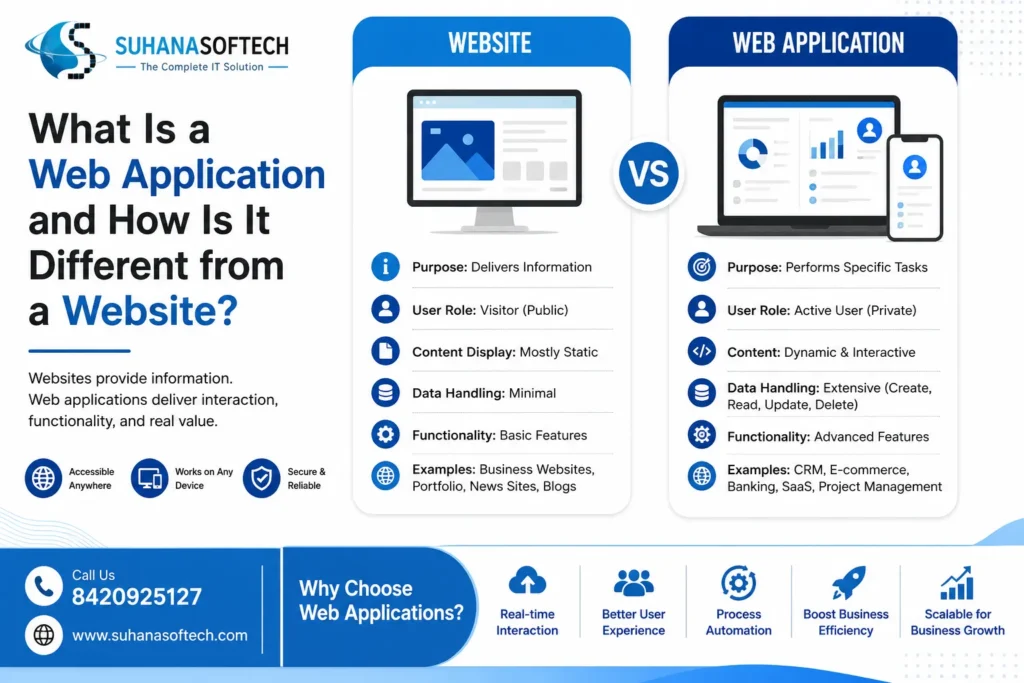
A website is primarily designed to deliver information to visitors. It allows users to browse content, learn about products or services, read articles, view images, and access company information. In contrast, a web application is built to facilitate interaction and functionality. Users can log in, manage data, complete transactions, communicate with others, and perform a wide range of tasks directly through their web browser.
As businesses continue to embrace digital transformation, choosing between a website and a web application has become a crucial decision. The right choice depends on factors such as business objectives, user requirements, scalability, and desired functionality. In this guide, we will explore what a web application is, how it works, the key differences between a website and a web application, and how to determine which solution is best suited for your business needs.
What Is a Web Application?
A web application, commonly known as a web app, is a software solution that operates through a web browser and allows users to interact with data and perform specific tasks online. Unlike traditional desktop software that requires installation on a computer, web applications can be accessed directly through the internet using a web browser, making them convenient and accessible from virtually anywhere.
Web applications are designed to deliver dynamic and interactive experiences. They enable users to create accounts, manage information, upload files, communicate with others, process transactions, and access personalized content in real time. From business management tools and customer portals to e-commerce platforms and online learning systems, web applications are built to simplify complex processes and improve user engagement.
Today, web applications play a significant role in both personal and professional environments. Popular services such as email platforms, project management systems, cloud-based document editors, online banking portals, and social networking platforms are all examples of web applications that millions of people use daily.
One of the biggest advantages of a web application is its flexibility and accessibility. Since the application is hosted on remote servers, users can access it from desktops, laptops, tablets, or smartphones without installing additional software. Updates, security improvements, and new features can also be deployed centrally, ensuring that all users automatically benefit from the latest version without any manual updates.
Common Examples of Web Applications
Web applications have become an essential part of everyday life, helping individuals and businesses perform tasks more efficiently through their web browsers. From communication and collaboration to entertainment and financial management, web applications are used across various industries. Below are some of the most common examples of web applications and how they benefit users.
Productivity Applications
Productivity-focused web applications help users create, organize, and collaborate on projects and documents from any location. These tools are widely used by businesses, educational institutions, and remote teams.
- Google Docs
- Microsoft 365 Online
- Trello
- Asana
- Notion
These platforms enable real-time collaboration, document sharing, task management, and workflow automation, making teamwork more efficient and productive.
Communication Applications
Communication web applications make it easier for people to stay connected, whether for personal conversations or business discussions.
- Gmail
- Outlook Web
- Slack
- Microsoft Teams
- Zoom Web
These applications provide features such as email management, instant messaging, video conferencing, file sharing, and team collaboration, helping organizations improve communication and productivity.
Entertainment Applications
Entertainment-based web applications allow users to access digital content instantly without downloading large files or software.
- Netflix
- Spotify Web Player
- YouTube Studio
- Disney+
Users can stream videos and music, manage subscriptions, personalize content preferences, and receive recommendations based on their viewing or listening habits.
Financial Applications
Financial web applications provide secure platforms for managing money, making payments, and accessing banking services online.
- Online Banking Portals
- PayPal
- Google Pay
- Digital Wallet Platforms
These applications offer secure payment processing, account management, fund transfers, transaction tracking, and other financial services that can be accessed anytime through a web browser.
How Does a Web Application Work?
Web applications function through a client-server architecture, a system that enables seamless communication between users and the application’s backend infrastructure. This architecture allows users to interact with online platforms in real time while data is processed securely on remote servers.
The Client Side
The client side represents the part of the web application that users directly interact with through a web browser. When a user accesses a web application, the browser loads the user interface and handles actions such as clicking buttons, submitting forms, searching for information, and entering data.
- Google Chrome
- Mozilla Firefox
- Microsoft Edge
- Safari
These browsers display the application’s interface and serve as a bridge between the user and the server. Modern client-side technologies such as HTML, CSS, and JavaScript help create responsive and interactive user experiences.
The Server Side
The server side is responsible for processing requests, managing business logic, and handling data storage. Whenever a user performs an action within a web application, the browser sends a request to the server. The server then processes the request, communicates with databases if required, performs calculations, and returns the appropriate response back to the user.
For example, when a customer logs into an online banking portal, the server verifies the login credentials, retrieves account details from the database, and securely displays personalized financial information on the user’s screen.
This constant exchange of information between the client side and server side enables web applications to deliver dynamic, interactive, and personalized experiences. Whether users are shopping online, managing projects, sending messages, or accessing business tools, client-server communication ensures that data is processed efficiently and displayed instantly.
Key Characteristics of Web Applications
Web applications have transformed the way businesses and individuals interact with digital services. Unlike static websites, web applications are built to deliver functionality, user engagement, and seamless accessibility. Their advanced capabilities make them an ideal solution for organizations that require interactive and data-driven experiences. Below are some of the key characteristics that define modern web applications.
Interactive User Experience
One of the most important features of a web application is its ability to provide a highly interactive user experience. Users can perform actions such as submitting forms, searching for information, uploading files, managing accounts, and interacting with data in real time. Every action triggers a response from the application, creating a dynamic and engaging environment.
Platform Independence
Web applications are designed to work across multiple operating systems and devices. Whether users access the application from Windows, macOS, Linux, Android, or iOS, they can enjoy a consistent experience through a compatible web browser without needing separate versions for each platform.
No Installation Required
Unlike traditional desktop software or mobile applications, web applications do not require users to download and install programs on their devices. Users simply enter a URL in their browser and gain instant access to the application, making deployment and usage significantly more convenient.
Automatic Updates
Since web applications are hosted on centralized servers, updates and feature enhancements can be implemented without requiring any action from users. This ensures that everyone always has access to the latest version, improved security measures, and new functionality without manual downloads or installations.
Cloud-Based Accessibility
Most web applications store data securely in cloud-based environments. This allows users to access their information from different devices and locations while maintaining synchronization and data consistency. Whether working from the office, home, or while traveling, users can continue their tasks without interruption.
Real-Time Collaboration
Modern web applications support real-time collaboration, enabling multiple users to work together simultaneously. Team members can edit documents, manage projects, share information, and communicate instantly within the same platform. This capability improves productivity, streamlines workflows, and enhances teamwork across organizations.
- Dynamic and interactive user experiences
- Compatibility across multiple devices and operating systems
- No software installation or maintenance required
- Automatic updates and centralized management
- Cloud-based access from anywhere with an internet connection
- Real-time collaboration and data synchronization
- Scalable architecture for growing business needs
What Is a Website?
A website is a collection of interconnected web pages that are accessible through a single domain name on the internet. Its primary purpose is to provide information, promote products or services, establish an online presence, and help visitors learn more about a business, organization, or individual. Websites serve as digital storefronts that allow users to access content anytime and from anywhere in the world.
Unlike web applications, which are built for user interaction and task execution, websites are primarily designed for content consumption. Visitors typically browse pages, read articles, view images, watch videos, explore service offerings, and gather information without needing to perform complex actions or interact with large amounts of data.
Websites play a crucial role in digital marketing, brand awareness, customer engagement, and online visibility. Businesses often use websites to showcase their expertise, generate leads, provide customer support information, and establish credibility in their industry.
Common Examples of Websites
- Company and corporate websites
- News and media portals
- Personal and professional blogs
- Portfolio and showcase websites
- Educational and informational websites
- Landing pages for marketing campaigns
- Non-profit and organization websites
Although modern websites may include interactive features such as contact forms, search functionality, newsletter subscriptions, chat widgets, and comment sections, their primary goal remains delivering information to visitors in a clear, organized, and engaging manner.
For businesses looking to establish a strong online presence, attract potential customers, and share valuable information, a professionally designed website is often the first and most important step in their digital journey.
Website vs Web Application: Quick Comparison
Although websites and web applications are both accessed through a web browser, they are designed to serve different purposes. A website is primarily focused on delivering information and content to visitors, while a web application is built to provide functionality, user interaction, and task-oriented experiences. The table below highlights the key differences between the two.
| Feature | Website | Web Application |
|---|---|---|
| Primary Purpose | Deliver information and content | Perform tasks and process data |
| User Interaction | Limited and mostly one-way | Highly interactive and dynamic |
| Authentication | Usually not required | Commonly required for user access |
| Data Processing | Minimal or limited | Extensive data handling and processing |
| Personalization | Basic or minimal | Advanced personalized experiences |
| Database Usage | Optional | Essential for storing and managing data |
| Complexity | Relatively simple | More complex architecture and functionality |
| Maintenance | Lower maintenance requirements | Requires regular updates and monitoring |
| Development Cost | Generally lower | Typically higher due to advanced features |
| User Accounts | Often unnecessary | Frequently required for personalized access |
In simple terms, if your goal is to provide information, promote your brand, or showcase products and services, a website is often the ideal choice. However, if users need to interact with data, manage accounts, complete transactions, or perform specific tasks, a web application offers the functionality and flexibility required to meet those needs.
User Interaction: The Biggest Difference
The most significant difference between a website and a web application lies in the level of user interaction they provide. While both are accessed through a web browser, the way users engage with them is fundamentally different. Understanding this distinction can help businesses choose the right solution based on their objectives and user requirements.
A website is primarily designed for information consumption. Visitors access content, browse pages, read articles, watch videos, and learn about products or services. Although websites may include basic interactive elements such as contact forms, search bars, or newsletter subscriptions, user engagement is generally limited to viewing and accessing information.
In contrast, a web application is built around user participation and functionality. Users actively interact with the system by creating content, updating information, managing accounts, submitting forms, processing transactions, and collaborating with other users. Every action triggers a response from the application, creating a dynamic and personalized experience.
Website Example
Consider a restaurant website. Its primary purpose is to provide visitors with useful information about the business.
- Restaurant menu
- Business location and directions
- Contact information
- Opening and closing hours
- Gallery of food and ambiance
In this scenario, visitors mainly browse and consume information without making significant changes to the system or interacting with complex functionality.
Web Application Example
Now consider a food delivery platform. This is a web application because users continuously interact with the system to complete various tasks.
- Create and manage user accounts
- Browse restaurants and menus
- Place food orders online
- Track deliveries in real time
- Make secure online payments
- Save favorite restaurants and preferences
- Review and rate orders
Unlike a traditional website, a web application responds to user actions, processes data, and delivers personalized results. This ongoing interaction is what makes web applications more dynamic, feature-rich, and suitable for businesses that require user engagement and transaction-based functionality.
Authentication and User Accounts
Another major difference between websites and web applications is the use of authentication and user account management. Most traditional websites are designed to provide the same information to every visitor, regardless of their location or identity. Whether a user accesses the website from India, the United States, Europe, or any other region, they typically view the same pages, content, and resources without needing to create an account.
Web applications, however, are built to deliver personalized experiences and secure access to user-specific information. To achieve this, they rely heavily on authentication systems that verify a user’s identity before granting access to certain features or data.
A typical web application may require users to:
- Create and register user accounts
- Log in securely using credentials
- Reset or recover forgotten passwords
- Manage personal profiles and settings
- Access personalized dashboards
- View account-specific information and activities
Authentication helps protect sensitive data while ensuring that users only access information relevant to their accounts. This capability is essential for platforms such as online banking systems, customer portals, e-learning platforms, healthcare applications, and membership-based services.
Data Management and Databases
Data management is one of the core elements that separates a web application from a traditional website. While websites are primarily focused on displaying information, web applications are designed to store, process, and manage large volumes of user-generated and system-generated data.
A standard website typically requires limited data storage because most of its content remains static and is displayed uniformly to all visitors. Database usage is often restricted to basic functions such as collecting inquiries or storing subscriber information.
A business website may only store:
- Contact form submissions
- Newsletter subscriptions
- Customer inquiries
- Basic website analytics and visitor data
In contrast, web applications depend heavily on databases to function effectively. Every user action often involves reading, writing, updating, or deleting information stored within a database.
Web applications regularly perform operations such as:
- Reading and retrieving stored information
- Creating new records and entries
- Updating user profiles and account details
- Deleting outdated or unnecessary data
- Generating reports and analytics
- Managing transactions and business processes
Examples of database-driven web applications include customer relationship management (CRM) systems, e-commerce platforms, healthcare management portals, learning management systems, inventory software, and online banking applications. These platforms rely on databases to deliver accurate information, maintain records, and provide seamless user experiences.
Without a robust database system, most modern web applications would be unable to support user accounts, process transactions, store records, or deliver the dynamic functionality that users expect. This extensive reliance on data management is one of the defining characteristics that distinguishes a web application from a traditional website.
Technology Behind Websites and Web Applications
Although websites and web applications are both accessed through web browsers, the technologies used to build them often differ based on their functionality and complexity. Websites generally focus on presenting information and content, whereas web applications are designed to handle user interactions, data processing, authentication, and business operations. As a result, web applications typically require a more sophisticated technology stack than traditional websites.
Technologies Commonly Used for Websites
Websites are usually built using technologies that focus on content presentation, responsive design, and basic user interaction. These technologies are ideal for creating company websites, blogs, portfolios, landing pages, and informational portals where the primary objective is to deliver content efficiently.
- HTML (HyperText Markup Language)
- CSS (Cascading Style Sheets)
- JavaScript
- WordPress
- Static Site Generators
These tools provide everything needed to create visually appealing, responsive, and search-engine-friendly websites. For most informational websites, this technology stack is sufficient to deliver content and support basic features such as contact forms, image galleries, and navigation menus.
Technologies Commonly Used for Web Applications
Web applications require a more advanced architecture because they must support dynamic functionality, user authentication, data management, and real-time interactions. To achieve this, developers use a combination of frontend frameworks, backend technologies, databases, APIs, and cloud services.
Frontend Technologies
Frontend technologies are responsible for the user interface and overall user experience. They enable web applications to provide responsive layouts, interactive components, and real-time updates.
- React JS
- Vue JS
- Angular
- Next.js
Backend Technologies
Backend technologies handle server-side processing, business logic, authentication, data validation, and communication with databases. They ensure that user requests are processed securely and efficiently.
- Node.js
- Python
- PHP
- Java
- .NET
Database Technologies
Databases are essential for storing, organizing, and retrieving application data. They allow web applications to manage user accounts, transactions, records, reports, and other critical information.
- MySQL
- PostgreSQL
- MongoDB
- Microsoft SQL Server
APIs and Cloud Infrastructure
Modern web applications often integrate with third-party services through APIs (Application Programming Interfaces). APIs enable features such as payment processing, social media integration, location services, email notifications, and communication between different software systems.
Cloud infrastructure also plays a crucial role in web application development by providing scalability, reliability, security, and high performance. Popular cloud platforms allow businesses to host applications, manage databases, store files, and handle large volumes of traffic efficiently.
By combining frontend frameworks, backend technologies, databases, APIs, and cloud services, developers can create powerful web applications capable of supporting complex business operations, personalized user experiences, and real-time functionality across multiple devices.
Web Application vs Traditional Desktop Application
When choosing software solutions, businesses often compare web applications and traditional desktop applications to determine which option best meets their operational requirements. While both are designed to help users perform tasks and improve productivity, they differ significantly in terms of accessibility, deployment, maintenance, and performance.
Web applications are delivered through a web browser and hosted on remote servers, whereas desktop applications are installed directly on a user’s computer. Understanding the strengths and limitations of each approach can help organizations make informed technology decisions.
Web Applications
Web applications have become increasingly popular because they offer convenience, accessibility, and centralized management. They enable users to access software from virtually any device with an internet connection.
No Installation Required
Users can access web applications directly through a web browser without downloading or installing software. This simplifies deployment and reduces technical barriers for end users.
Cross-Platform Compatibility
A single web application can operate across multiple platforms, including Windows, macOS, Linux, Android, and iOS. Users experience consistent functionality regardless of the device they use.
Automatic Updates
Since web applications are hosted on centralized servers, updates and new features can be deployed instantly. Users automatically access the latest version without manual downloads or installations.
Lower Maintenance Costs
Organizations only need to maintain one centralized application rather than supporting multiple installations across different devices and operating systems. This reduces maintenance efforts and long-term operational costs.
Access from Anywhere
Web applications allow users to access their accounts, files, and business tools from any location with an internet connection, making them ideal for remote work and distributed teams.
Limitations of Web Applications
- Typically require an active internet connection
- Performance may depend on network speed and server availability
- Limited access to certain device hardware features
- May experience latency during complex operations
Desktop Applications
Desktop applications are installed directly on a user’s computer and run locally on the device. They are commonly used for resource-intensive tasks that require high performance and deep system integration.
Better Offline Functionality
Desktop software can continue operating without an internet connection, making it suitable for environments where connectivity is limited or unreliable.
Faster Local Processing
Because processing occurs directly on the user’s device, desktop applications often deliver superior performance for graphics-intensive, engineering, video editing, and data-heavy operations.
Deeper Hardware Integration
Desktop applications can interact directly with local hardware components such as printers, scanners, cameras, storage devices, and specialized equipment, providing greater functionality in certain industries.
Enhanced Resource Utilization
Desktop software can leverage the full power of a device’s CPU, memory, and storage resources, making it ideal for demanding professional applications.
Limitations of Desktop Applications
- Requires installation on each device
- Manual software updates may be necessary
- Different versions may be needed for different operating systems
- Higher maintenance and support requirements
- Limited accessibility when users switch devices
Which Option Is Better for Modern Businesses?
For many modern organizations, web applications have become the preferred choice due to their accessibility, scalability, and lower maintenance requirements. They support remote work, centralized management, and seamless updates, making them ideal for customer portals, e-commerce platforms, learning management systems, CRM software, and cloud-based business tools.
However, desktop applications remain valuable for industries that require offline functionality, advanced hardware integration, or high-performance computing. The right choice ultimately depends on business objectives, user requirements, security considerations, and the type of functionality the software must provide.
When Should You Choose a Website?
A website is the ideal choice when your primary objective is to establish an online presence, share information, promote your brand, and attract potential customers. Websites are designed to communicate information effectively, helping businesses build credibility and connect with their target audience without requiring extensive user interaction or complex data processing.
Whether you are a startup, small business, educational institution, or large enterprise, a professionally designed website can serve as a powerful marketing and communication tool that supports long-term business growth.
Brand Awareness and Credibility
A website acts as your digital storefront, helping visitors learn about your company, values, products, and services. A strong online presence enhances brand recognition and builds trust among potential customers.
Information Sharing
Businesses can use websites to provide detailed information about their offerings, company history, customer support resources, pricing, and contact details, making it easier for visitors to find the information they need.
Content Marketing
Publishing blogs, articles, guides, tutorials, and industry insights helps businesses attract visitors, demonstrate expertise, and improve search engine visibility through content marketing strategies.
Lead Generation
Websites can include inquiry forms, consultation requests, quote forms, and newsletter subscriptions that help businesses capture leads and convert visitors into potential customers.
Product and Service Showcasing
A website provides an excellent platform for displaying products, services, portfolios, case studies, testimonials, and success stories that encourage visitors to engage with your business.
Search Engine Visibility
An SEO-optimized website can improve rankings on search engines, increase organic traffic, and help potential customers discover your business when searching for relevant products or services online.
Common Examples of Websites
- Corporate business websites
- Blogs and content publishing platforms
- Educational and informational websites
- News and media portals
- Portfolio and showcase websites
- Landing pages for marketing campaigns
These platforms are primarily designed to provide information, build trust, promote services, and generate leads rather than handle extensive user interactions or complex business processes.
When Should You Choose a Web Application?
A web application is the better choice when users need to interact with the platform, manage information, complete tasks, perform transactions, or access personalized features. Unlike traditional websites, web applications are built to support dynamic functionality and provide customized experiences based on individual user actions.
Businesses that require customer portals, workflow automation, online booking systems, learning platforms, SaaS products, or data-driven solutions often benefit more from web application development.
Create and Manage User Accounts
Web applications allow users to register accounts, log in securely, manage profiles, update settings, and access personalized services tailored to their specific needs.
Store and Manage Information
Users can save documents, records, preferences, transaction histories, and other important information within secure databases, ensuring easy access and data consistency.
Process Transactions
Web applications support online payments, subscriptions, bookings, order management, invoicing, and other business transactions that require real-time processing.
Enable Team Collaboration
Many web applications allow users to collaborate with colleagues, clients, or team members by sharing files, assigning tasks, communicating, and working together in real time.
Automate Business Workflows
Organizations can streamline operations by automating repetitive tasks, managing approvals, tracking projects, generating reports, and monitoring business performance through a centralized platform.
Provide Personalized Dashboards
Web applications can deliver customized dashboards, notifications, reports, and recommendations based on user roles, activities, and preferences, creating a more engaging experience.
Common Examples of Web Applications
- Customer Relationship Management (CRM) systems
- Learning Management Systems (LMS)
- E-commerce platforms
- Online banking applications
- Project management software
- Healthcare management portals
- Software as a Service (SaaS) platforms
- Food delivery and booking applications
If your business requires users to interact with data, complete transactions, collaborate with others, or access personalized features, a web application provides the functionality, scalability, and flexibility needed to support long-term growth and operational efficiency.
Common Web Application Examples
Web applications are widely used across industries to simplify operations, improve customer experiences, and automate business processes. Unlike traditional websites, these platforms are designed to handle user interactions, manage large volumes of data, and provide personalized functionality. Below are some of the most common types of web applications used by modern businesses and organizations.
- Customer Relationship Management (CRM) Systems – Help businesses manage customer interactions, sales pipelines, leads, and support activities.
- Enterprise Resource Planning (ERP) Platforms – Integrate business functions such as finance, inventory, human resources, procurement, and operations into a single system.
- E-Commerce Applications – Allow customers to browse products, place orders, make payments, and track deliveries online.
- Online Banking Portals – Enable users to manage accounts, transfer funds, pay bills, and monitor financial activities securely.
- Software-as-a-Service (SaaS) Platforms – Deliver cloud-based software solutions that users can access through a web browser without installing software locally.
- Project Management Tools – Help teams organize tasks, collaborate on projects, track progress, and improve productivity.
These web applications are built to support advanced functionality, real-time communication, database management, automation, and personalized user experiences. As businesses continue to digitize their operations, web applications have become essential tools for improving efficiency, scalability, and customer satisfaction.
Future of Web Applications
The future of web applications is being shaped by rapid advancements in cloud computing, artificial intelligence (AI), machine learning, automation, and Progressive Web Application (PWA) technologies. Modern users expect fast, secure, and highly personalized digital experiences, and web applications are evolving to meet these demands.
Today’s next-generation web applications increasingly offer features such as:
- Offline functionality and local data storage
- Real-time synchronization across devices
- AI-powered automation and smart recommendations
- Enhanced security and data protection mechanisms
- Improved speed, scalability, and performance
- Mobile-app-like user experiences through Progressive Web Apps (PWAs)
- Cloud-native architecture for greater flexibility
- Integration with IoT devices and third-party services
Organizations across industries are investing heavily in web application development because these platforms provide unmatched accessibility, flexibility, and scalability. Whether supporting remote teams, serving global customers, or automating business operations, web applications continue to play a central role in digital transformation strategies.
As technology advances, web applications will become even more intelligent, responsive, and user-centric, helping businesses improve customer engagement, streamline operations, and remain competitive in an increasingly digital marketplace.
Conclusion
While websites and web applications may appear similar on the surface, their core purpose and functionality are fundamentally different. A website is primarily designed to deliver information, educate visitors, showcase products or services, and build brand awareness. In contrast, a web application is built to enable users to perform tasks, interact with data, collaborate with others, and access personalized features.
If your primary goal is to inform, educate, market your business, improve search engine visibility, or generate leads, a website is often the most practical and cost-effective solution. However, if your users need account management, personalized dashboards, workflow automation, payment processing, data management, or advanced interactive features, a web application is the better choice.
Understanding the differences between websites and web applications allows businesses to make informed technology decisions that align with their objectives, user expectations, and long-term growth plans. By selecting the right solution, organizations can deliver better user experiences, improve operational efficiency, and create a strong foundation for future innovation and digital success.


